
A weekly review is a short, fixed session, usually 30 to 60 minutes once a week, in which you clear your inboxes and notes, update your task and project lists, look at last week’s and next week’s calendar, and pick your priorities for the coming week. Its job is to make sure nothing important is held only in your head.
Where the weekly review comes from
The weekly review is a core part of Getting Things Done, the method David Allen set out in his book of the same name. Allen describes it as whatever you need to do to get your head empty again, and he splits it into three parts: get clear, get current and get creative. You do not need to follow the rest of his system to benefit from this one habit.
Pick a fixed time
The review only works if it happens every week, so give it a slot that rarely gets taken. Friday afternoon suits people who like to close the week; Monday morning suits those who prefer to plan with a fresh head. The day matters less than keeping it. Put it in the calendar as a recurring meeting with yourself.
The 30-minute checklist
Get clear (10 minutes)
- Empty your email inbox to the point where every remaining message has a next step or a home.
- Collect loose notes, voice memos and screenshots, and put each one in its proper place.
- Write down anything that is still on your mind and is not in a list yet.
Get current (15 minutes)
- Look back at last week’s calendar for follow-ups you have not recorded.
- Look ahead at the next two weeks for anything that needs preparation.
- Go through your task list: tick off what is done, delete what no longer matters.
- Check each active project has at least one clear next action.
- Review your waiting-for list and chase anything overdue.
Get creative (5 minutes)
- Choose the three priorities that would make next week a success.
- Glance at your someday list and promote anything whose time has come.
- Note one thing to do differently next week, based on how this one went.
Three questions that make it a review, not just a cleanup
Ticking boxes keeps your system tidy; reflecting is what improves the next week. Before you close, answer three short questions in writing:
- What did I get done compared with what I planned?
- What got in the way?
- What will I change next week?
Kept over a few months, these answers show patterns no app will: the meeting that always overruns, the task you keep postponing, the day of the week you get the most done.
Common reasons it stops
- It takes too long. Start with 30 minutes and a short checklist; you can extend it later.
- It gets skipped in busy weeks. Those are the weeks it is most useful. Do a shortened version rather than none.
- The lists live in too many places. One task list and one calendar make the review twice as fast.
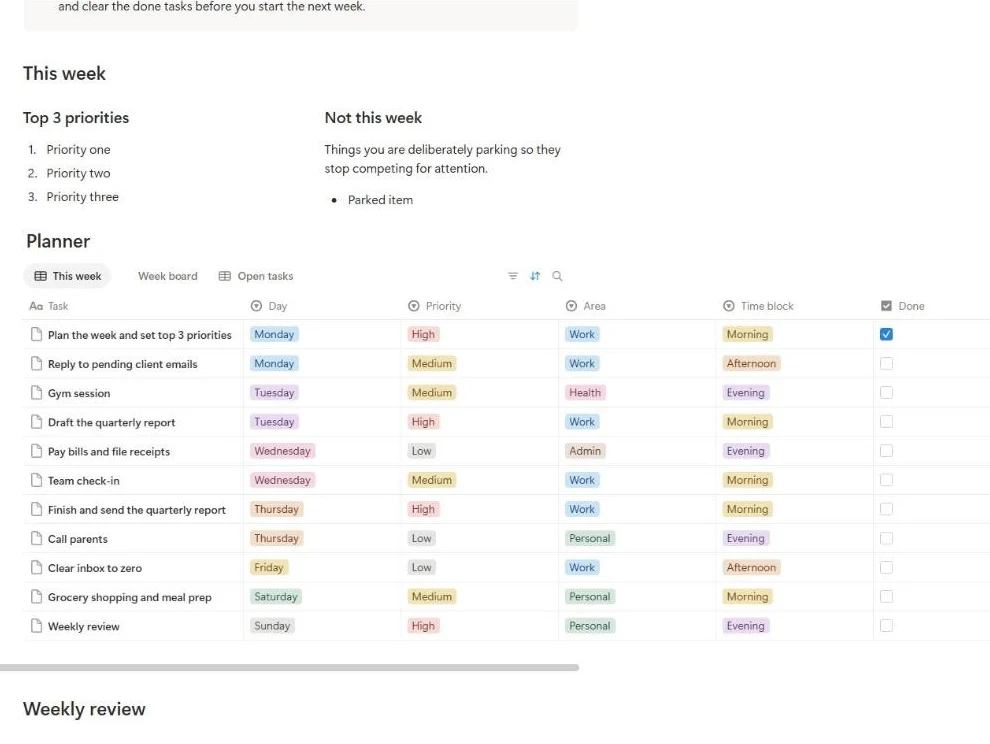
Free Weekly Planner Template for Notion
Top three priorities, a board of tasks by day and a weekly review section with the three questions above. Duplicate it and start this week.
If you prefer paper-style lists, the to-do list template works well alongside a weekly review too.
FAQ
How long should a weekly review take?
Thirty minutes is enough for most people once the habit is established. The first few may take an hour while you clear the backlog.
What is the best day for a weekly review?
Whichever day you can protect every week. Friday afternoon and Monday morning are the most common choices.
Do I need the full Getting Things Done system?
No. The weekly review works with any task list or planner, including a paper notebook.
Is a weekly review useful for teams?
Yes, as a short team version: what shipped, what is blocked and the top priorities for next week. Keep it separate from status meetings so it stays short.