
To take useful meeting notes, prepare a page with the agenda before the meeting, then capture only three things as you go: decisions made, action items with one owner and a due date each, and questions left open. Skip the back-and-forth. Clean the notes up and send them within an hour.
Why most meeting notes go unread
Long notes that try to record the whole conversation are hard to write and nobody reads them. Formal minute-taking settled this question a long time ago: Robert’s Rules of Order says minutes should be mainly a record of what was done at the meeting, not what was said. The same principle works for a Tuesday team call. People need to know what was decided and what they have to do, not who argued for what.
There is also a memory reason to write things down promptly. Ebbinghaus’s forgetting curve, replicated in a 2015 study, shows that a large share of new information fades within the first day unless it is reinforced. Notes sent the same day are that reinforcement.
Before the meeting: set up the page
- Title, date and attendees.
- The agenda, one heading per item.
- Under each heading, three empty labels: Decisions, Actions, Open questions.
- Links to anything people should read beforehand.
Five minutes of preparation means that during the meeting you fill in blanks instead of designing a document.
During the meeting: capture three things
Decisions
Write each decision as a complete sentence someone who missed the meeting would understand: “We will launch the spring campaign on 3 March, two weeks later than planned, because the supplier is late.” Include the reason when it is short; it saves the same debate next week.
Action items
Use one format for every action: [Owner] will [action] by [date]. One owner per item, never “the team”. If an action comes up without an owner or a date, ask out loud before moving on: “Who takes that, and by when?” It takes five seconds and is the single most useful thing a note-taker can do.
Open questions
Anything raised but not resolved goes here, with the name of whoever will find the answer. Open questions are what turn into next week’s agenda.
What to leave out
- Who said what, unless the attribution matters for a decision.
- Discussion that did not lead anywhere.
- Your opinion of the discussion.
- Anything confidential that should not go to the full distribution list.
After the meeting: send within the hour
Tidy the wording, move all action items into one list at the top, and send the notes while everyone still remembers the meeting. Putting actions first matters: many people read only the top of the message. At the start of the next meeting, review last time’s action list before anything else. That habit alone does more for follow-through than any tool.
Different meetings, different notes
- One-to-ones: keep a running page per person so you can see past commitments.
- Project meetings: link actions to the project tracker so they do not live in two places.
- Client calls: send a short written recap to the client too; it prevents misunderstandings about what was agreed.
- Formal or board meetings: follow your organisation’s rules for minutes, which may require motions and votes to be recorded exactly.
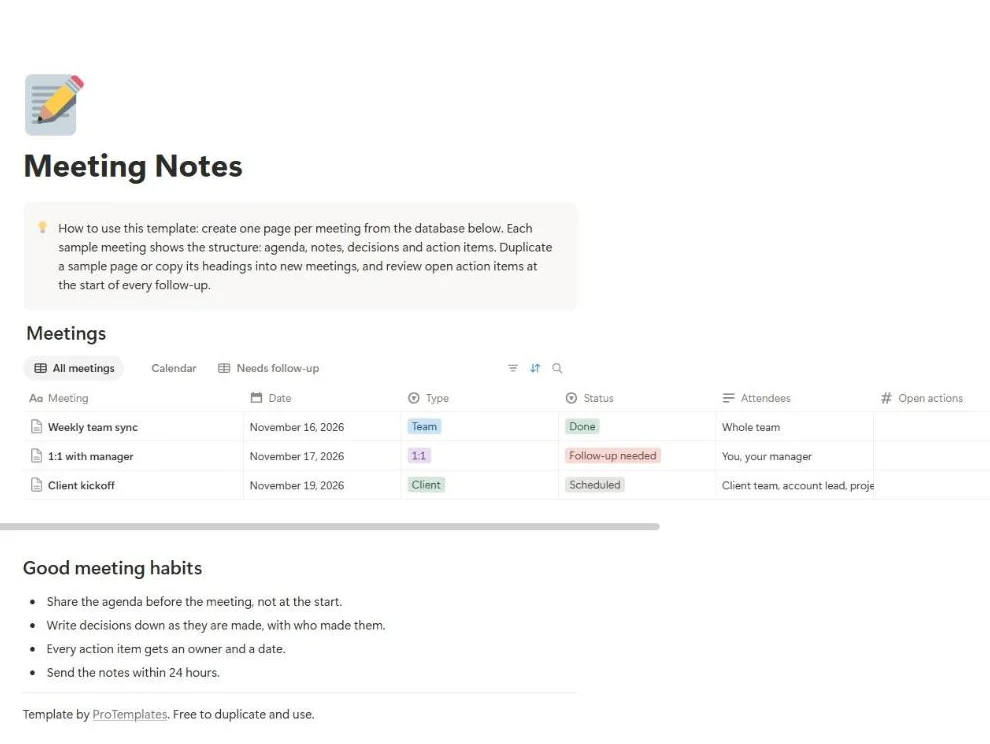
Free Meeting Notes Template for Notion
A Notion database with agenda, decisions and action items for every meeting, plus a view that collects every open action in one place.
FAQ
What is the difference between meeting notes and minutes?
Minutes are a formal record, usually for boards and committees, and often follow set rules about motions and votes. Meeting notes are informal and focus on decisions and actions for the team.
Should the meeting leader take the notes?
Ideally not. Running a meeting and recording it at the same time means doing both badly. Rotate the note-taker role among attendees.
Is it fine to record the meeting instead?
A recording is useful as a backup, but nobody rewatches an hour of video to find one decision. You still need a short written list of decisions and actions.
How detailed should action items be?
Detailed enough that the owner could start without asking anyone what was meant. If an action needs a paragraph of context, link to it rather than writing it into the list.