
To calculate overtime under US federal law, add up the hours worked in the workweek, take everything over 40 as overtime and pay those hours at one and a half times the employee’s regular rate. The regular rate is usually the hourly wage, but it must include non-discretionary bonuses and shift differentials, which changes the result.
The federal rule in three parts
The Fair Labor Standards Act sets the baseline for most private employers. The Department of Labor’s Fact Sheet 23 summarises it: covered, non-exempt employees must receive overtime pay of at least one and a half times their regular rate for hours worked over 40 in a workweek. Three words in that sentence do most of the work.
- Workweek: a fixed, recurring period of 168 hours, seven consecutive 24-hour periods. It can start on any day and hour, but it cannot shift week to week, and hours cannot be averaged across two weeks.
- Hours worked: time the employee is required or allowed to work, including tasks done before or after a shift.
- Regular rate: all pay for the week, with a short list of exclusions, divided by the hours worked.
Federal law does not require extra pay for weekends, holidays or nights as such, and it does not cap hours for adults. It only requires the premium once the weekly total passes 40.
Example 1: a plain hourly wage
An employee earns $20 an hour and works 46 hours.
- Regular pay: 40 hours x $20 = $800.
- Overtime rate: $20 x 1.5 = $30.
- Overtime pay: 6 hours x $30 = $180.
- Total for the week: $980.
Example 2: an hourly wage plus a bonus
Same employee, same 46 hours, plus a $60 productivity bonus that was promised in advance. That makes it non-discretionary, so it belongs in the regular rate.
- Straight-time earnings: (46 x $20) + $60 = $980.
- Regular rate: $980 / 46 = $21.30.
- Overtime premium: 6 hours x ($21.30 x 0.5) = $63.91.
- Total for the week: $980 + $63.91 = $1,043.91.
The half-time premium is used here because the straight-time pay for all 46 hours is already counted in the $980. Leaving the bonus out would have underpaid the employee by $3.91 that week, which is small until it is multiplied across a team and two or three years of back pay.
Example 3: two jobs at two rates
An employee works 30 hours on the shop floor at $18 and 15 hours driving deliveries at $24, all for the same employer, in one week.
- Straight-time earnings: (30 x $18) + (15 x $24) = $900.
- Regular rate: $900 / 45 = $20.
- Overtime premium: 5 hours x $10 = $50.
- Total: $950.
Example 4: a salaried, non-exempt employee
A salary does not by itself make someone exempt. An employee on $800 a week whose salary is meant to cover 40 hours, and who works 44, has a regular rate of $800 / 40 = $20. The four overtime hours are owed at $30 each, so the week pays $920. Different rules apply when the salary is agreed to cover whatever hours are worked (the fluctuating workweek method), which is worth checking with a payroll adviser before using.
What goes into the regular rate
Fact Sheet 56A explains that the regular rate includes all pay for employment unless the law specifically excludes it. In practice:
- Included: hourly wages, salary, commissions, non-discretionary bonuses (attendance, production, retention bonuses promised in advance) and shift differentials.
- Excluded: truly discretionary bonuses, gifts such as a holiday gift not tied to hours or output, expense reimbursements, and pay for time not worked such as holidays and vacation.
Who is exempt
Executive, administrative and professional employees can be exempt if they pass both a duties test and a salary test. Following court rulings that vacated the 2024 increase, the Department of Labor formally restored the 2019 threshold in May 2026: at least $684 a week ($35,568 a year) on a salary basis, and $107,432 a year in total pay for the highly compensated employee exemption. Job titles decide nothing; an “assistant manager” who mostly runs the till and earns $700 a week is likely non-exempt.
State rules that go further
Where a state law is more generous, the employee gets the better rule. California is the best known example: overtime after 8 hours in a day, double time after 12, and premium pay on the seventh consecutive day of work, on top of the weekly rule. Several states also set higher salary thresholds for exempt status. Always check the state where the work is done.
Mistakes that lead to back pay
- Averaging two weeks of 35 and 45 hours into “80 hours, no overtime”. Each workweek stands alone.
- Paying time and a half on the base wage only, ignoring promised bonuses.
- Giving time off later instead of overtime pay. In the private sector, comp time does not replace the premium.
- Not counting work before clock-in or after clock-out, such as answering messages or setting up equipment.
- Assuming everyone on a salary is exempt.
Overtime and federal income tax
From tax year 2025, employees who receive qualified overtime pay may deduct the premium portion of it on Schedule 1-A of their federal return, up to $12,500 ($25,000 for joint filers). It changes nothing about how much overtime the employer must pay; it only affects the employee’s income tax.
For more on staffing, scheduling and payroll paperwork, see our HR templates guide.
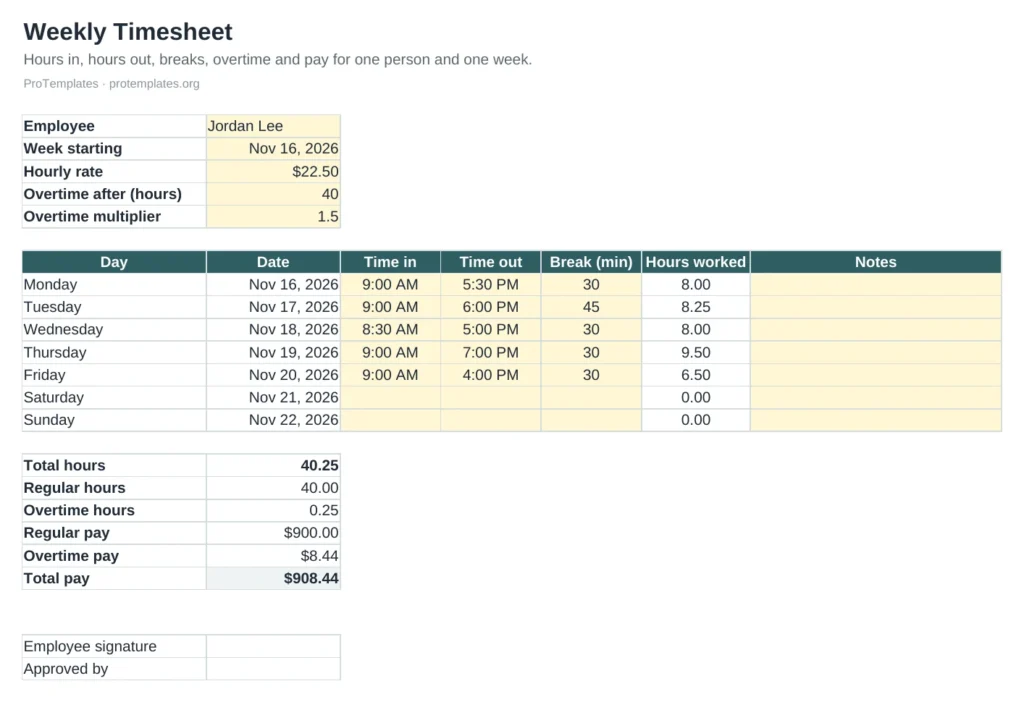
Free Weekly Timesheet Template for Excel
Time in, time out and breaks per day, with total, regular and overtime hours and pay calculated above the weekly threshold you set.
The template multiplies hours by the hourly rate you enter. In weeks with a non-discretionary bonus, calculate the adjusted regular rate first, as in Example 2, and use it for the overtime line.
FAQ
Can an employee agree to give up overtime pay?
No. The FLSA requirement cannot be waived by agreement, and an announcement that overtime will not be paid unless authorised in advance does not remove the obligation for hours actually worked.
When must overtime be paid?
Generally on the regular payday for the period in which the overtime was worked. If the hours cannot be calculated in time, it should be paid as soon as practicable, normally the next payday.
Is overtime calculated on gross or net pay?
On gross pay. The regular rate is built from earnings before taxes and deductions.
Do paid holidays count towards the 40 hours?
Not under federal law. Hours paid but not worked, such as a holiday or sick day, do not count as hours worked for the 40-hour test, although a union contract or company policy can be more generous.
Is double time required anywhere?
Not under federal law. Some states require it in specific cases, such as California after 12 hours in a day.