
An employee onboarding checklist should cover four phases: before day one (paperwork, equipment, accounts), the first day (welcome, tour, first task), the first month (training, introductions, goals) and the first 90 days (check-ins and a review). Give every item an owner, because most onboarding failures are tasks nobody thought were theirs.
Why a checklist matters
Onboarding is one of the weakest processes in most organisations. Gallup found that only 12% of employees strongly agree their organisation does a great job of onboarding new hires, and that people typically take around a year to reach their full potential in a role. A checklist will not fix culture, but it stops the basics from falling through the cracks: the laptop that arrives on day three, the system access nobody requested, the manager who forgot the start date.
Talya Bauer’s report for the SHRM Foundation describes onboarding in terms of four Cs: compliance, clarification, culture and connection. Most companies stop at the first. The checklist below covers all four.
Before day one
- Send the offer letter and contract, and collect signed paperwork and tax forms (HR).
- Order the laptop, phone and any equipment (IT or office manager).
- Create email and system accounts with the right permissions (IT).
- Send a welcome email with start time, location or video link, dress code and who to ask for (manager).
- Choose an onboarding buddy who is not the manager (manager).
- Plan the first week’s calendar, including at least one real task (manager).
Day one
- Welcome in person or on video at the start time, not an hour later (manager).
- Hand over equipment and check that every login works (IT).
- Tour of the office or the main tools and channels (buddy).
- Explain the first week’s plan and what good looks like by the end of it (manager).
- Lunch or a coffee with the team (buddy).
- Complete a small first task that ships, so the day ends with something done (manager).
First week
- Introductions to the people they will work with most, with a line on why each matters (manager).
- Walk through the key processes and documents for the role (buddy or team lead).
- Required compliance training: security, data protection, health and safety (HR).
- A short end-of-week check-in: what is clear, what is confusing (manager).
First month
- Agree three to five goals for the first 90 days, written down (manager and new hire).
- Shadow a colleague on the core tasks of the role (buddy).
- Weekly one-to-ones, kept even when the calendar is busy (manager).
- Explain how the team’s work connects to the company’s goals (manager).
First 90 days
- Check-ins at 30, 60 and 90 days against the goals agreed in month one (manager).
- Ask for feedback on the onboarding itself and fix what did not work (HR).
- Formal end of the probation period, if there is one, with a written outcome (HR and manager).
Bauer’s research for SHRM notes that new employees get about 90 days to prove themselves, which is why the checklist runs at least that long. Gallup goes further and argues onboarding should be treated as a process that lasts most of the first year.
Common mistakes
- Treating onboarding as an orientation day. Paperwork on day one is not onboarding.
- No owner per task. “HR will sort it” is how laptops arrive late.
- An empty first week. New hires who sit reading documents for five days start wondering if they made the right choice.
- Skipping the manager. The manager’s involvement shapes the experience more than any document.
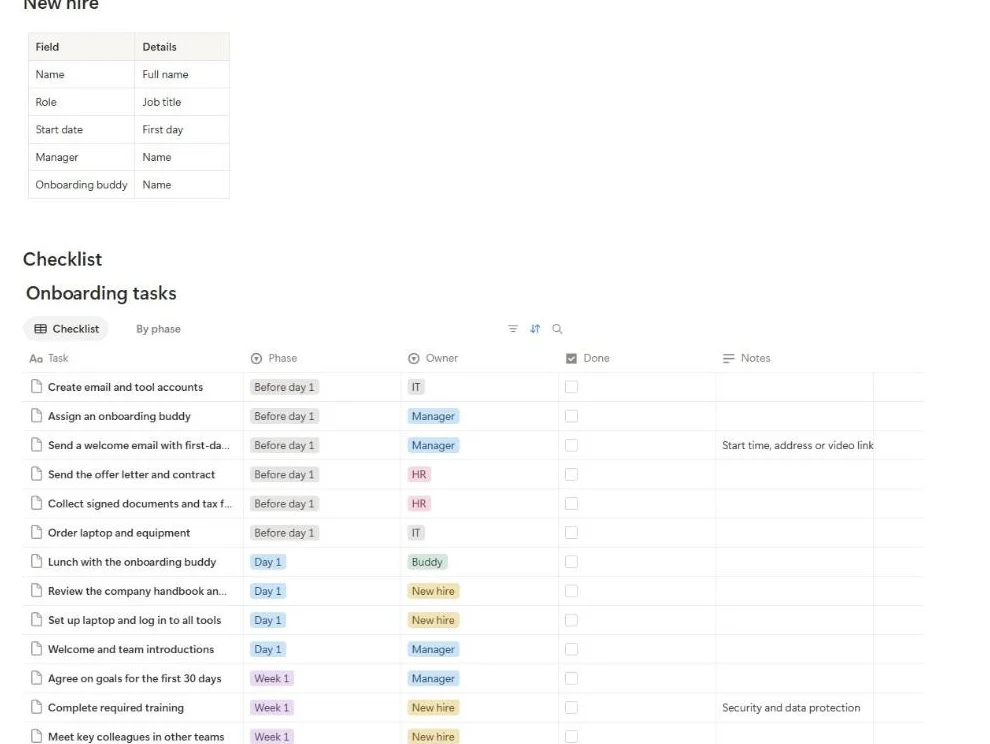
Free Employee Onboarding Checklist for Notion
Every task above, grouped by phase with owners and due dates. Duplicate it for each new hire and track progress on a board.
FAQ
How long should onboarding last?
At least 90 days for the structured part. Many organisations keep regular check-ins running for the first six to twelve months.
What is the difference between orientation and onboarding?
Orientation is the first day or two: paperwork, equipment and a welcome. Onboarding is the whole period it takes someone to become fully productive and connected to the team.
Who should own the onboarding checklist?
HR usually owns the process, but the hiring manager owns most of the items that matter: the plan, the goals and the check-ins.
Does remote onboarding need a different checklist?
The phases are the same. Add shipping equipment early, scheduled video introductions instead of a tour, and more frequent short check-ins in the first two weeks.